
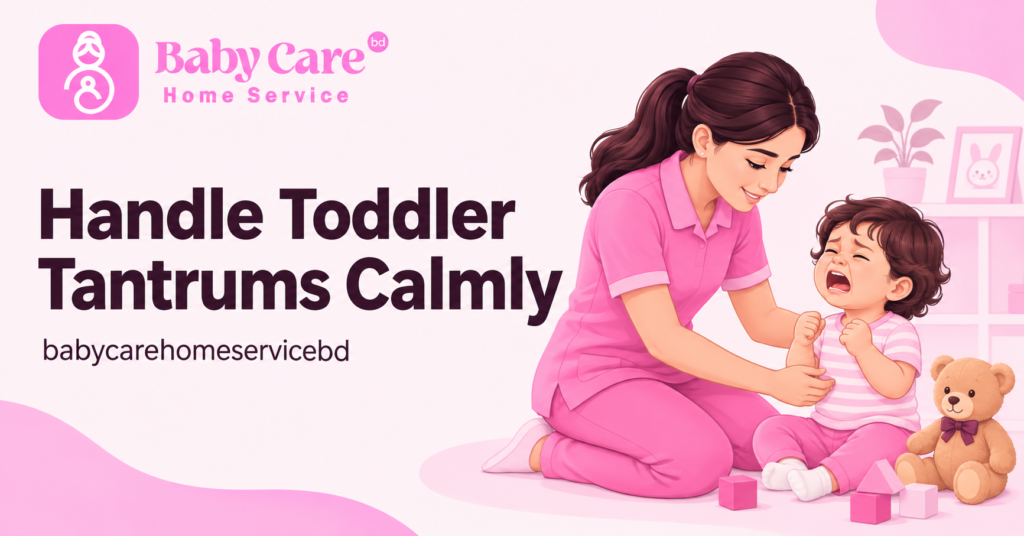
How to Handle Toddler Tantrums Without Losing Your Cool
It is six in the evening in a busy Dhaka flat. Your two-year-old wants the red cup, but it is still in the wash. Seconds later, she is flat on the floor, screaming as if the world has ended. Your heart races. Everyone is looking. What now?
If this sounds like your home, relax. Almost every parent asks how to handle toddler tantrums at some point. The good news is that tantrums are normal. You can also learn to deal with them calmly.
In this guide, you will learn how to handle toddler tantrums step by step. We will cover why they happen, what to do in the moment, how to stop them early, and when to ask for help. We will also see how a trained nanny can make childcare easier for busy families in Dhaka.
What Are Toddler Tantrums?
A toddler tantrum is a sudden burst of crying, screaming, kicking or throwing things. It happens when a young child feels upset but cannot explain it in words. It is a normal part of growing up.
Most children start having tantrums around 12 to 18 months. They peak between ages 2 and 3, then slowly fade. According to the American Academy of Child and Adolescent Psychiatry, a toddler tantrum usually lasts between two and 15 minutes. It can include screaming, falling to the floor, hitting, kicking or biting.
Think of a pressure cooker. Feelings build up inside a small body, and the only way to let off steam is a big noise. Your child is not “bad.” Your child is overwhelmed. Knowing this makes it much easier to learn how to handle toddler tantrums.
Why Do Toddlers Have Tantrums?
Toddlers have tantrums because their feelings are bigger than their words and their self-control. They want to be independent, but they cannot do everything alone yet.
A toddler’s brain is still growing. The part that helps with calm thinking is far from ready. At the same time, your child is learning to say “no” and “mine.” That is a tough mix.
Here are the most common triggers:
| Trigger | What Is Really Going On | Everyday Example |
|---|---|---|
| Hunger or tiredness | The body is low on energy, so patience is gone | A meltdown just before lunch or nap time |
| Wanting control | The child wants to do things alone | Pushing your hand away when you help with shoes |
| Not enough words | The child cannot explain the feeling | Crying and pointing at the fridge |
| Hearing “no” | The child feels blocked | You say no to chocolate before dinner |
| Noise and crowds | Too much for little senses | A loud family gathering |
| Change in routine | The day looks different, so the child feels unsure | A new house, a trip, or a new caretaker |
Notice that most triggers are simple needs. Once you spot the real cause, half the work is done. Language matters too. Toddlers who can say more words often have milder tantrums. That is why daily talking and reading help so much. You can find easy ideas in our guide on early language development.
Once you know the cause, how to handle toddler tantrums becomes much clearer.
How to Handle Toddler Tantrums: What to Do Right Now
Stay calm, keep your child safe, say very little, and wait for the storm to pass. Comfort your child once they are calm, then talk about it in a few simple words.
These seven steps show how to handle toddler tantrums while they are happening:
| Step | What to Do | Why It Works |
|---|---|---|
| 1 | Take a slow, deep breath | Your calm helps your child calm down |
| 2 | Check that the area is safe | Sharp, hot or heavy things can hurt |
| 3 | Get down to your child’s eye level | The child feels seen, not scolded |
| 4 | Name the feeling in short words | It teaches your child the right words |
| 5 | Stay close and say little | Too many words add more noise |
| 6 | Wait it out | The tantrum ends faster without a big reaction |
| 7 | Hug first, talk later | Comfort comes before any lesson |
Step 1: Calm yourself first
Your child copies your mood. If you shout, the tantrum grows. Breathe in slowly. Count to five. Drop your shoulders. It is fine to feel angry. Just do not act on it.
Step 2: Keep everyone safe
If your toddler is kicking or throwing things, gently move them to a safe spot. A soft rug or a bed works well. Take away anything that can hurt them or break.
Step 3: Name the feeling
Use short lines like, “You wanted the red cup. You feel sad. I know.” Do not argue about the cup in the middle of a meltdown. A child in a full tantrum cannot listen to reasons. The brain is busy with big feelings.
Step 4: Stay close and wait
Sit near your child. Do not bribe them with a phone or a sweet. If they push you away, stay a step back and say, “I am here when you are ready.” This shows how to handle toddler tantrums with love and firm rules together.
Step 5: Comfort, then guide
When the storm is over, give a hug. Then say one or two lines: “Next time, you can say ‘help me.’” Keep it short. Your child learns more from your calm than from a long talk.
What Should You Not Do During a Tantrum?
Do not shout, hit, shame or give in. These actions make tantrums worse or teach your child that screaming gets results.
Knowing how to handle toddler tantrums also means knowing what to avoid.
| Don’t Do This | Do This Instead |
|---|---|
| Shout “Stop it right now!” | Speak low and slow |
| Hit or threaten the child | Step back and breathe |
| Give a phone or chocolate to end it | Hold the rule kindly |
| Say “Big boys don’t cry” | Say “It is okay to feel upset” |
| Lecture in the middle of it | Wait until your child is calm |
| Compare with a cousin or neighbour’s child | Focus on your own child |
Giving in is the trickiest one. Say your toddler screams at the shop and you buy the chocolate. Your child learns, “Screaming works.” Next time, the scream will be louder. Pediatric experts also say that spanking, yelling and shaming do not help in the long run. Stay kind, and stay firm.
How to Handle Toddler Tantrums in Public Places
Stay calm, ignore the stares, move your child to a quiet spot, and wait. Do not give in just because people are watching.
Public tantrums feel scary, but how to handle toddler tantrums outside is almost the same as at home. In Dhaka, the usual trouble spots are crowded markets, long traffic jams, big weddings and busy restaurants. Everyone around may stare. Remember, most of them have been in your shoes.
| Place | Common Trigger | Quick Fix |
|---|---|---|
| Grocery shop | Wants snacks on the shelf | Give a small job, like “hold the list” |
| Family wedding | Noise, waiting, tiredness | Take a quiet corner break and carry a snack |
| Car or CNG ride | Boredom or hunger | Sing songs, play a window game, offer water |
| Restaurant | Waiting for food | Bring crayons or a small toy |
A few smart habits help. Carry water and a healthy snack. Tell your child the plan before you leave: “We will buy rice and then go home.” If the tantrum does not stop, pick up your child and leave for a few minutes. Return when both of you are calm.
Why Do Tantrums Happen More at Bedtime?
Tantrums happen more at bedtime because toddlers are tired, and tired children have less patience. A steady routine helps a lot.
An overtired toddler often cries over small things. A dark room can also feel scary. Try a fixed pattern: bath, pyjamas, story, lights off. Do it at the same time each night. If bedtime fights are a daily problem, read our guide on sleep training toddlers. Families who need extra rest can also look at our night baby care service.
How to Prevent Toddler Tantrums Before They Start
Keep a steady daily routine, meet basic needs on time, give small choices, and warn your child before changes. Prevention stops many tantrums before they begin.
Prevention is half of how to handle toddler tantrums. Here are five habits that work.
Keep a steady routine
Toddlers feel safe when the day follows a pattern. Meals, naps and play should happen at about the same time. Surprises are hard for small children.
Feed and rest your child on time
Many tantrums are really hunger or sleepiness in disguise. Offer a healthy snack before you go out. Do not skip the afternoon nap. A good feeding plan also helps, and our baby feeding service can support families who need it.
Offer small choices
Toddlers want control. So give them some, in safe ways. Ask, “Do you want the blue shirt or the green one?” Both are fine with you, and your child feels proud.
Give a warning before changes
Say, “Five more minutes of play, then bath time.” Toddlers do not understand time well, but a warning still helps them get ready.
Catch good behavior
When your child waits, shares or calms down, say so. “Thank you for waiting. That was hard, and you did it!” Praise makes good behavior happen more often. Spend ten minutes of full attention with your child every day, too. Many tantrums are just a cry for attention.
How to Handle Toddler Tantrums by Age
The core steps stay the same, but your approach should change as your child grows. Younger toddlers need distraction and comfort. Older ones can start learning words for feelings.
Here is how to handle toddler tantrums at each stage:
| Age | What Tantrums Look Like | Best Approach |
|---|---|---|
| 12–18 months | Crying, arching the back, throwing food | Distract, use simple words, meet needs fast |
| 18–24 months | Dropping to the floor, screaming, saying “no!” | Stay close, name the feeling, offer two choices |
| 2–3 years | Hitting, biting, longer meltdowns | Set calm limits, use a safe space, teach words |
| 3–4 years | Shorter bursts, more talking back | Talk about feelings, solve problems together, praise calm |
Most children have fewer tantrums as their language grows. By age 3 or 4, the number usually drops a lot.
Should You Use Time-Out for Tantrums?
A short, gentle break can help a toddler calm down. It should never feel like a punishment or a scary event.
Time-out can be part of how to handle toddler tantrums, if you use it gently. Make a “calm corner” with a soft cushion and a book. Keep the break short, only a few minutes. Stay nearby so your child does not feel alone. When the time is up, give a hug and move on. The goal is to teach calming down, not to scare your child.
When Is a Tantrum Not Normal?
See a doctor if tantrums are very long, happen many times a day, or the child often hurts themselves or others. Also ask for help if they stay severe after age 4 or 5.
Most of the time, the tips on how to handle toddler tantrums in this guide will be enough. But sometimes a tantrum is a sign of something more.
| Usually Normal | Talk to a Doctor |
|---|---|
| Lasts a few minutes | Goes on for a very long time |
| Happens now and then | Happens many times every day |
| Child calms down and plays again | Child cannot be calmed |
| Mostly between ages 1 and 3 | Still severe after age 4 or 5 |
| Child is otherwise happy and growing well | Also has speech delay, sleep or eating problems |
Trust your gut. If you are worried, a visit to your child’s doctor is always a good idea.
How Can a Nanny Help With Toddler Tantrums?
A trained nanny can keep daily routines steady, spot triggers early, stay calm and follow the same rules as parents. This makes tantrums shorter and less frequent.
Many working parents in Dhaka depend on professional nanny care. A trained nanny can show you how to handle toddler tantrums with steady routines and a calm voice. She spends many hours with your child. That means she learns what makes your child upset, and she can step in before the meltdown starts.
Good nanny services also bring useful skills beyond tantrums. A caring baby caretaker watches meals, naps, safety and play. If your child has special health needs, nursing care at home may be a good choice. Home care is easier for toddlers, too, because they stay in a place they know. You can read about our approach to baby monitoring and our full range of nanny care on the Baby Care Home Service BD homepage.
What to look for in a nanny agency
Not every nanny agency is the same. Before you choose, check these things:
| What to Check | Why It Matters |
|---|---|
| Training in childcare | Trained caregivers know how to stay calm |
| Background check | Your child’s safety comes first |
| Patience and warmth | Toddlers need gentle people |
| Clear talk with parents | Rules stay the same at home |
| Flexible hours | Full-time, part-time or night support fits your life |
You can see our plans on the pricing page and check the areas we cover on the service area page.
How to Handle Toddler Tantrums When You Are Not at Home
A good baby caretaker knows how to handle toddler tantrums by staying calm, keeping the child safe and avoiding shouting. But she needs your help. Share your rules clearly. Tell her your child’s favorite comfort toy, nap time and common triggers. Ask her to give you a short update at the end of each day.
Keep everyone on the same page
In many Dhaka homes, grandparents, aunts and parents all care for the child. If one person gives in and another says no, your toddler gets confused. When everyone knows how to handle toddler tantrums the same way, children feel safe and tantrums fade faster. Our guide on raising a baby in a joint family has simple tips for this.
Conclusion
Learning how to handle toddler tantrums takes time and a lot of patience. You will have good days and hard days. That is normal. Tantrums are not a sign that you are a bad parent or that your child is bad. They are a sign that your little one is learning big feelings.
In short, how to handle toddler tantrums comes down to five things:
- Stay calm yourself.
- Keep your child safe.
- Name the feeling, and say little.
- Stay firm and never give in to screaming.
- Comfort your child, then guide them.
If you need extra hands, you do not have to do it alone. Baby Care Home Service BD offers trained nannies and caregivers for childcare at home in Dhaka. Our team can support your child’s routine, safety and daily care, so you get peace of mind. Book a visit today or call our hotline at +8801739-508350.
Frequently Asked Questions (FAQ)
1. How to handle toddler tantrums at 2 years old?
Stay calm, keep your child safe and use short words like “You are upset.” Do not give in to the demand. Hug your child once they calm down.
2. How to handle toddler tantrums in public?
Move your child to a quiet spot and wait. Ignore the stares. If it does not stop, leave for a few minutes and return when both of you are calm.
3. How to handle toddler tantrums without yelling?
Take a deep breath, lower your voice and get down to your child’s level. Speaking slowly keeps both of you calm. That is how to handle toddler tantrums without shouting.
4. At what age do toddler tantrums stop?
Tantrums usually peak between ages 2 and 3. They get less common as language improves, often by age 3 or 4. Every child is different.
5. Should I ignore a toddler tantrum?
Ignore the screaming, but not the child. Stay close and safe, and do not give in. Comfort your child as soon as they are calm.
6. Is it normal for a toddler to have tantrums every day?
Yes, many toddlers have a tantrum almost daily. It is normal if they are short and your child calms down. See a doctor if they are very long, severe or harmful.
7. How to handle toddler tantrums at night?
Keep a steady bedtime routine, keep lights soft and make sure your child is not hungry or overtired. Stay calm and keep your replies short and gentle.
8. Can a nanny help with toddler tantrums?
Yes. A trained nanny keeps routines steady, notices triggers and stays calm. Using the same rules as the parents helps your child feel safe and cuts down on meltdowns.