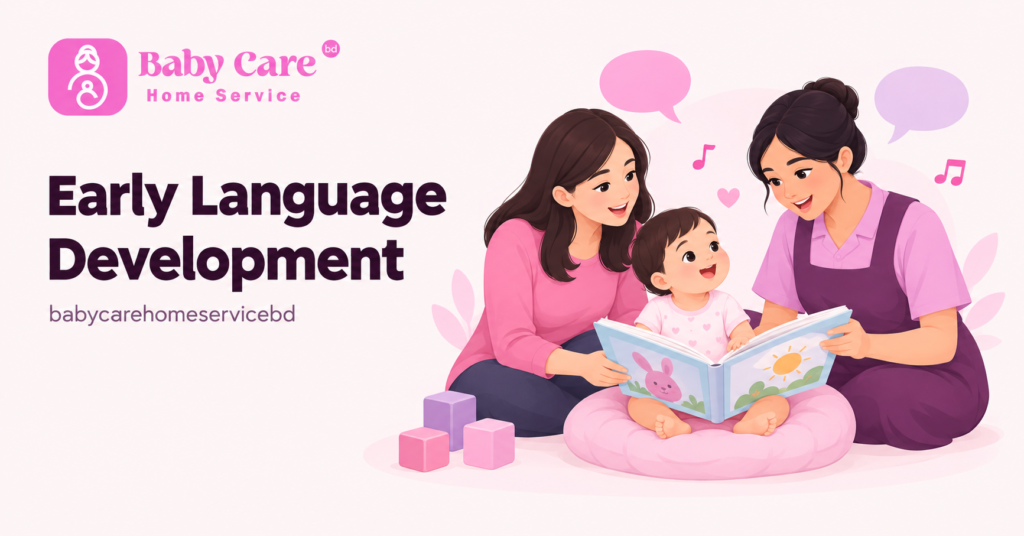
Your baby is two months old. You lean over the cot and say, “Hello, my sweet girl.” She stares at your mouth and lets out a soft “ooh.” You laugh and say “ooh” back.
That tiny chat is the start of early language development. Most parents think talking begins with the first word. It actually begins on day one, the moment your baby hears your voice.
This guide explains early language development in simple words. You will learn what to expect at each age and what to do at home every day. You will also learn how a nanny can help and when to ask a doctor. If you live in Dhaka and balance work with childcare, these tips are made for a busy home.
New to all this? Our first-time parents survival guide is a good place to start.
What Is Early Language Development?
Early language development is the way a baby learns to understand sounds, words, and gestures, and then starts using them to talk. It begins at birth and grows fast in the first three years.
Think of it as two skills growing side by side. The first is understanding. Your baby knows “milk” or “Papa” long before she can say them. The second is speaking. That comes later, with coos, babbles, first words, and then short sentences.
Understanding always runs ahead of speaking. A one-year-old may follow “Bring me the ball” but say only two or three words. That is normal.
The brain grows fastest in the first three years of life. So early language development gets its biggest push in this window. Every song, chat, and story you share builds a base for school and life.
Why Is Early Language Development Important?
Early language development helps children think, share feelings, make friends, and get ready for school. A child who can say “I am hungry” or “I am sad” has less reason to scream out of frustration.
| Area of life | How strong language skills help |
|---|---|
| Feelings | The child can tell you what is wrong instead of crying or hitting |
| Friendships | Easier to play, share, and take turns |
| School | Listening, reading, and writing come more easily |
| Thinking | The child can ask questions and remember things |
| Confidence | A child who is understood feels safe and proud |
Strong early language development does not mean your child must be an early talker. Some children start late and catch up. What matters is steady progress and a home full of words.
What Is a Parent’s Role in Early Language Development?
A parent’s role in early language development is simple: talk, listen, read, sing, and play with your baby every day. You do not need costly toys or classes. You are your child’s first teacher.
Here are the habits that matter most.
Talk About Everything You Do
Narrate your day. While cooking, say, “I am cutting the onion. See, it is round.” While changing a diaper, say, “Now we wash your feet. Splash!” It feels silly at first. But your baby is soaking up every word.
Wait and Respond
When your baby makes a sound, stop and look at her. Say something back. Then wait. This back-and-forth is like a game of catch. You throw a sound, she throws one back. Taking turns is the base of every real conversation.
Read and Sing Every Day
Books are not only for big kids. Even a three-month-old loves the rhythm of your voice and bright pictures. Sing Bangla rhymes and lullabies, like “Aay Aay Chand Mama.” Ten minutes a day is enough. A bedtime story also helps build a calm sleep routine.
Use Real Names for Things
Baby talk is cute in play. But also say the real word, such as “water,” not only “wawa.” Name body parts, foods, animals, and family members.
Keep Screens Low
A phone or TV cannot answer your baby’s coo. Babies learn language from people who look at them and talk with them. Doctors advise very little screen time for children under two.
How Does Early Language Development Happen Month by Month?
Babies usually coo by 2 months, babble by 6 months, say a first word near 12 months, and join two words by about 2 years. Every child moves at their own pace. Treat these ages as a guide for early language development, not a test.
| Age | What your baby may do | What you can do |
|---|---|---|
| 0–3 months | Cries, coos, turns toward your voice | Talk face to face, smile, sing softly |
| 4–6 months | Laughs, makes sounds like “ba” and “ga” | Copy her sounds, then wait for her reply |
| 7–9 months | Babbles strings like “ba-ba-ba,” looks when you say her name | Play peek-a-boo, name objects |
| 10–12 months | Waves bye-bye, understands “no,” may say a first word | Point and name things, read picture books |
| 12–18 months | Says a few words, points to show what she wants | Say the word for what she points at |
| 18–24 months | Learns new words fast, joins two words like “more milk” | Add to her words: “Yes, more milk, please” |
| 2–3 years | Speaks short sentences, asks “what” and “why” | Answer questions, tell stories, sing together |
The CDC offers a free developmental milestones checklist that you can use to track your child’s progress.
Which Daily Activities Boost Early Language Development at Each Age?
Simple play like talking, singing, naming objects, and reading picture books supports early language development at every age. You do not need to set aside special time. Fit these into daily tasks.
| Daily moment | Language activity | Example |
|---|---|---|
| Bath time | Name body parts | “Wash your hands, wash your tummy” |
| Feeding time | Talk about food | “This is soft rice. It is warm.” See our baby feeding service |
| Diaper change | Eye contact and songs | Sing a short rhyme every time |
| Walk or balcony time | Name what you see | “Look, a bird! A rickshaw! A big truck!” |
| Play time | Copy and add words | Baby says “ba,” you say “ball, big ball” |
| Bedtime | Read or sing | One short story, same time each night |
Should You Speak Bangla or English With Your Baby?
Speak the language you know best. Babies learn from natural, warm talk. Many families in Dhaka use both Bangla and English at home. That is fine. Babies can learn two languages at once.
A parent who speaks warmly and clearly in Bangla gives better early language development support than one who speaks stiff, broken English. If you want your child to learn English too, add it through books, songs, and short daily phrases. Do not drop your mother tongue.
Can a Nanny or Baby Caretaker Help With Early Language Development?
Yes. A kind, trained nanny or baby caretaker who talks, sings, and plays with your child can support early language development well. But a nanny adds to your role. She does not replace it.
In many homes in Dhaka, both parents work. A baby may spend 8 to 12 hours a day with a nanny. Those hours are full of chances to learn words. They can also be wasted if the caretaker keeps the child quiet in front of a phone.
This is why the quality of nanny care matters. At Baby Care Home Service BD, we send trained and verified caregivers for daily baby care at home. Ask them to follow your talking routine, just like a feeding or sleep routine. Our newborn baby care service and night baby care service both include daily time with your baby.
What to Look for in Nanny Services
Not all nanny services are the same. When you choose a nanny agency, check these points.
| What to check | Why it matters |
|---|---|
| Talks warmly to the baby all day | Babies learn from voices |
| Speaks clearly in your home language | Your child hears one steady language |
| Sings and reads, even for a few minutes | Builds a love of words |
| Keeps phone and TV time low | More real talk, less screen |
| Is patient and waits for baby to respond | Gives your child time to try |
| Is background-checked by the nanny agency | Safety comes first |
| Shares a short daily update | You know what new sounds or words came |
How to Work With Your Nanny
Keep it simple. Share three or four rhymes you sing. Give her a short list of “words of the week,” like ball, water, mama, and bird. Ask her not to use TV during play time.
In the evening, take five minutes to ask, “What new sound did she make today?” It keeps everyone on the same team. Not sure which setup suits you? Read our guide on live-in vs part-time nanny service in BD.
Does Home Care or Nursing Care Matter for Language Skills?
It can. Babies born early or after a long illness may reach milestones a little later. In such cases, home care from a trained nurse or caregiver can help you follow the doctor’s advice and watch your baby’s progress.
A nurse or caregiver can also notice if your baby does not react to sounds and tell you right away. You can then ask your doctor about a hearing check. If you need this kind of support, see our pricing plans for caregiver and nursing care options.
What Mistakes Slow Down Early Language Development?
The most common mistakes are too much screen time, too little talk, and rushing the child to speak. The good news is that every one of them is easy to fix.
| Common mistake | Better habit |
|---|---|
| Handing a phone to keep baby quiet | Give a toy, sing, or talk about what you see |
| Finishing every word for the child | Wait a few seconds and let her try |
| Using only baby talk | Use baby talk in play, but say the real word too |
| Asking only yes/no questions | Ask “What is this?” or “Where is the ball?” |
| Comparing with the neighbor’s child | Watch your own child’s steady progress |
| Staying silent while busy with chores | Narrate what you are doing |
| Correcting harshly when she says it wrong | Repeat the right word kindly: “Yes, a ball!” |
When Should You Worry About Early Language Development?
Talk to a doctor if your baby does not respond to sounds, does not babble by 12 months, or loses words she once knew. Most delays in early language development improve with early help. So do not wait and worry alone.
| Age | Possible warning sign |
|---|---|
| By 6 months | Does not turn toward sounds or voices |
| By 12 months | No babbling, no pointing, no waving |
| By 18 months | Says very few words and does not try to copy sounds |
| By 24 months | Does not put two words together |
| Any age | Loses words or skills, or rarely makes eye contact |
Hearing problems are one common and fixable cause of late talking. A simple hearing test can give clear answers. A speech therapist can also help if needed. Remember, a warning sign is not a final answer. It is only a reason to get checked.
A Simple Daily Routine for Early Language Development
You can support early language development in under an hour a day, spread across your normal routine. Here is a sample plan for a working family.
| Time | Activity | Who can do it |
|---|---|---|
| Morning | Say good morning, name the clothes while dressing | Parent or nanny |
| Midday | Walk, name things you see, sing | Nanny or caretaker |
| Afternoon | Picture book for 10 minutes | Nanny or caretaker |
| Evening | Talk about the day, play with a toy together | Parent |
| Bedtime | Lullaby and a short story | Parent |
Even on tired days, a few warm minutes count more than a perfect plan.
Conclusion
Early language development is not about flashcards or fancy apps. It is about everyday moments: a song while you cook, a story at bedtime, and a patient pause when your baby tries a new sound. Your voice is the best teaching tool your child will ever have.
Here is a quick recap:
- Talk, sing, and read every day, in the language you know best.
- Wait and respond when your baby makes sounds.
- Keep screens low.
- Choose a warm, trained nanny or caretaker who talks with your child, not just watches her.
- Check with a doctor if you notice warning signs.
Need a trusted nanny, baby caretaker, or nursing care for your baby in Dhaka? Baby Care Home Service BD is ready to help. Book a visit today and give your child loving care that also helps them learn to talk.
Frequently Asked Questions (FAQs)
1. What is early language development?
It is how a baby learns to understand and use sounds, words, and gestures in the first few years. It starts at birth, with listening, and moves to babbling, first words, and sentences.
2. At what age do babies start talking?
Most babies say their first word around 12 months. Some start a little earlier or later. Cooing and babbling before that are also part of talking.
3. How can I help my baby talk?
Talk to her all day, respond to her sounds, read, and sing. Name things around you and give her time to reply. Daily habits matter more than special toys.
4. Is it bad if my baby speaks late?
Not always. Many children are late talkers and catch up. But if your child has very few words by 18 to 24 months, or does not respond to sounds, see a doctor.
5. Does TV or mobile affect early language development?
Yes, too much screen time can reduce real talk with people. Babies learn best from faces and voices that answer back. Keep screens very low for children under two.
6. Can a nanny help with a child’s speech?
Yes. A caring nanny who talks, sings, and plays with your child adds many hours of language practice. Choose a trained caregiver from a trusted nanny agency, and share your language routine with her.
7. Is it okay to use two languages at home?
Yes. Children can learn two languages together. Speak clearly and warmly in each one, and do not drop your mother tongue.
8. When should I see a doctor about my child’s talking?
See a doctor if your baby does not react to sounds, does not babble by 12 months, or loses words she used before. Early checks and help give the best results.