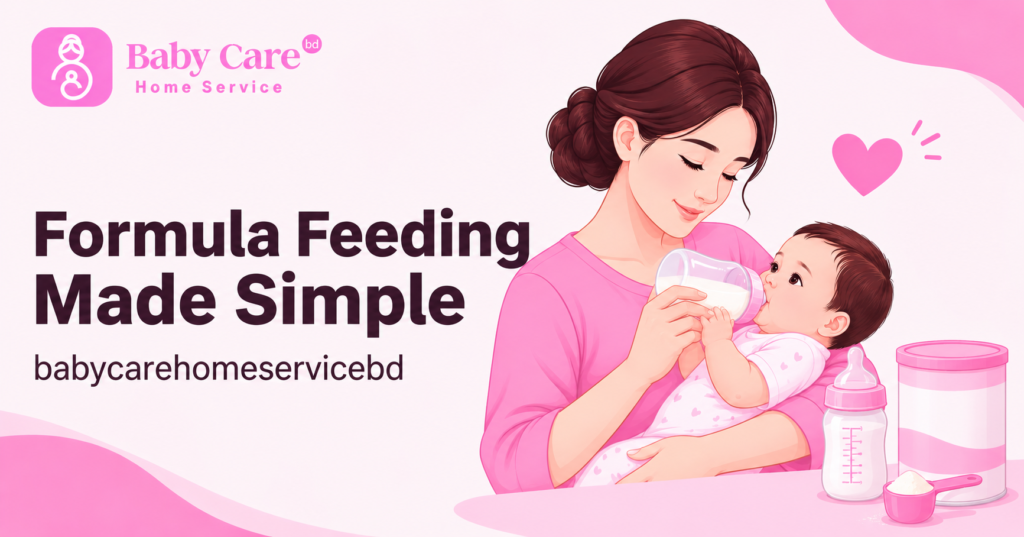
Bringing a baby home is a happy time. It also fills your head with questions. One of the biggest is simple: how do I feed my baby the right way?
Maybe your breast milk is not enough. Maybe you are going back to work soon. Maybe your doctor asked you to use formula. Whatever the reason, you are not alone. Many loving parents in Dhaka use formula every day, and their babies grow up healthy and strong.
This guide to formula feeding for beginners explains everything in plain words. You will learn how to pick a formula, mix it, feed your baby, clean bottles and spot problems early. Once you know the basics, formula feeding for beginners feels less scary and more like a normal part of your day.
What Is Formula Feeding and Is It Safe for a Newborn?
Formula feeding means giving your baby infant formula milk from a bottle, either instead of breast milk or along with it. It is safe when you choose the right formula, mix it as the tin says and keep everything clean.
Infant formula is made in factories to give babies what they need in the first year. It has protein, fat, sugar, vitamins and minerals. Doctors around the world accept it as a safe choice for babies who are not fully breastfed.
The key to formula feeding for beginners is not the brand name. It is the habit. Clean hands, clean bottles and correct mixing solve most problems before they start.
Should I Choose Formula, Breast Milk or Both?
Breast milk is the best first food when it is possible. But formula feeding for beginners is a safe and healthy path when breastfeeding is hard, painful or not enough. Many mothers use both, and that is perfectly fine.
Every family is different. A mother who works long hours, a baby who is not gaining weight or a low milk supply can all lead to formula. Feeling guilty helps nobody. A fed, happy baby is the goal.
| Feeding Option | Good Points | Things to Watch |
|---|---|---|
| Breast milk only | Free, always ready, right temperature | Takes a lot of the mother’s time |
| Formula only | Anyone can feed; you see how much baby drinks | Costs money; needs careful mixing |
| Both (mixed feeding) | Flexible for working mothers | Needs a routine to keep milk supply steady |
Formula feeding for beginners does not mean you must stop breastfeeding. If you want to keep some breastfeeding going, read our breastfeeding tips for first time mothers. Working moms can also learn how to store breast milk, so a caregiver can bottle-feed it while you are away.
What Do I Need Before Starting Formula Feeding for Beginners?
You need the right formula, four to six clean bottles with nipples, a bottle brush, a pot for sterilizing, a flask of safe water and a notebook. Buy these before your baby needs them.
| Item | Why You Need It |
|---|---|
| Infant formula (right age stage) | Your baby’s main food |
| 4–6 bottles with slow-flow nipples | One in use, others washing or drying |
| Bottle brush | Cleans corners a cloth cannot reach |
| Steel pot or steam sterilizer | Kills germs on bottles |
| Flask of boiled water | Makes night feeds quick |
| Notebook | Tracks feeds, wet diapers and sleep |
Many parents rush out at midnight to buy formula. Try not to. Buy one small tin first. If your baby feeds well and has no tummy trouble, buy a bigger one.
How Do I Choose the Right Formula for My Baby?
Choose a formula made for your baby’s age, bought from a trusted shop, with a clear expiry date. Start with a standard milk-based formula unless your doctor says otherwise.
The tin can look confusing when you start formula feeding for beginners. Here is a simple way to read it.
| Type | Best For | Note |
|---|---|---|
| Stage 1 (0–6 months) | Newborns and young babies | The usual starting choice |
| Stage 2 (6–12 months) | Older babies who also eat solids | Ask your doctor if it is needed |
| Special formulas | Babies with a health issue | Only on a doctor’s advice |
| Ready-to-feed liquid | Travel or emergencies | Costs more, needs no mixing |
A few easy rules help:
- Check the seal and expiry date every time. Skip dented or open tins.
- Buy from a shop you trust, because fake tins do exist.
- Do not switch brands again and again. Give a new formula a few days.
- Never give homemade formula, plain cow’s milk or rice water to a baby under one year.
How Do I Make Formula Step by Step?
Wash your hands, boil water and let it cool a little, then pour the water into the bottle first. Add the exact number of level scoops, mix well and test the heat on your wrist.
Mixing is the heart of formula feeding for beginners. Too much powder is hard on a baby’s body. Too little leaves your baby hungry and may slow growth. Always follow your tin, because each brand has its own scoop size.
| Step | What to Do |
|---|---|
| 1 | Wash your hands with soap and clean the counter |
| 2 | Check the expiry date and wipe the tin lid |
| 3 | Boil water and let it cool for no more than 30 minutes |
| 4 | Pour the water into a clean bottle first |
| 5 | Add level scoops, leveled with a clean knife |
| 6 | Close the bottle and swirl until the powder dissolves |
| 7 | Cool the bottle in a bowl of cold water if needed |
| 8 | Drip a few drops on your wrist. It should feel warm, not hot |
Should the water be boiled? Powder formula is not completely free of germs. That is why health groups like the WHO suggest mixing it with water that was boiled and cooled for no more than 30 minutes. In formula feeding for beginners, water matters as much as powder. Tap water can differ from place to place in Bangladesh, so safe boiled water is a smart habit. Ask your baby’s doctor what they prefer. The US CDC also has a clear page on infant formula preparation and storage.
Warming the bottle: Babies can drink formula at room temperature or slightly warm. Stand the bottle in a bowl of warm water. Never use a microwave. It heats unevenly and can leave hot spots that burn a baby’s mouth.
How Much Formula Does a Baby Need?
A newborn drinks about 30 to 60 ml per feed in the first week. This grows to about 180 to 240 ml per feed by six months. Every baby is different, so watch your baby, not just the clock.
| Baby’s Age | Amount per Feed (approx.) | Feeds per Day (approx.) |
|---|---|---|
| First week | 30–60 ml | 8–12 |
| 1 month | 90–120 ml | 6–8 |
| 2 months | 120–150 ml | 5–6 |
| 4 months | 120–180 ml | 5–6 |
| 6 months | 180–240 ml | 4–5, plus solids |
These are rough numbers. Do not worry about exact figures in formula feeding for beginners. Your baby’s doctor will guide you using weight and growth. Around six months, solid food begins, and our guide on first solid food for baby can help with that next step.
How Do I Know If My Baby Is Hungry or Full?
A hungry baby sucks on fingers, turns toward the bottle and opens the mouth. A full baby turns the head away, slows down or falls asleep. Crying is a late sign of hunger.
| Hungry Signs | Full Signs |
|---|---|
| Sucking fingers or fist | Turning head away |
| Smacking lips | Slowing down or stopping |
| Turning toward the bottle | Pushing the nipple out |
| Fussing, then crying | Relaxed hands, sleepy face |
Do not force the last few drops. Feeding by cues, not by force, is a big part of formula feeding for beginners. It also helps your baby learn to stop when full.
How Do I Bottle-Feed My Baby Safely?
Hold your baby half upright, tilt the bottle so the nipple stays full of milk and feed slowly. Burp your baby during and after the feed. Never prop up a bottle and walk away.
Hold your baby close, the way you would in breastfeeding. Look at them and talk softly. Feeding is bonding time, not just meal time.
Let your baby take small breaks every few minutes. This is called paced feeding, and it cuts down gas and spit-up. Pick the right nipple, too. Newborns need slow flow. If milk gushes out or your baby chokes, the flow is too fast. Never let a baby fall asleep with a bottle in the mouth. It can cause choking and later tooth problems.
How Do I Clean and Sterilize Baby Bottles?
Wash all parts in warm soapy water with a brush right after each feed, rinse well and sterilize by boiling for 5 minutes or using a steam sterilizer. Let everything air dry on a clean surface.
| When | What to Do |
|---|---|
| After every feed | Take the bottle apart and rinse at once |
| Washing | Use warm soapy water and a brush, including inside the nipple |
| Sterilizing | Boil 5 minutes or use a steam sterilizer, especially in the early months |
| Drying | Air dry on a clean rack, not with a cloth |
| Storing | Keep covered in a clean, dry place |
Clean bottles are the base of safe formula feeding for beginners. Most tummy upsets in babies come from dirty equipment, not from the milk.
How Long Can Prepared Formula Stay Out?
Use prepared formula within 2 hours. Once your baby starts drinking, finish within 1 hour. If you store it in the fridge, use it within 24 hours. Throw away leftovers after a feed.
| Situation | Safe Time Limit |
|---|---|
| Prepared, at room temperature | Within 2 hours |
| After baby starts drinking | Finish within 1 hour, then discard |
| Prepared, in the fridge | Use within 24 hours |
| Prepared, in the freezer | Do not freeze |
| Opened powder tin | Check the label; most say about 4 weeks |
These limits match CDC advice. Time rules matter a lot in formula feeding for beginners, because germs grow fast in warm milk, and Dhaka’s heat makes it worse.
How Do I Know the Formula Suits My Baby?
A baby who suits the formula feeds well, has 6 or more wet diapers a day, sleeps between feeds and gains weight steadily. Some spit-up and soft stools are normal.
| Normal | Call Your Doctor |
|---|---|
| Small spit-up after feeds | Vomiting again and again |
| Soft, yellow or tan stools | Blood in stool or very hard stools |
| Some gas and fussiness | Fever or very sleepy baby |
| 6+ wet diapers a day | Far fewer wet diapers |
| Steady weight gain | Rash, swelling or refusing feeds |
Give your baby a week or two to settle. In formula feeding for beginners, small changes in poop and sleep are common at first. If something feels wrong, trust your gut and call the doctor.
What Are the Most Common Mistakes in Formula Feeding for Beginners?
The most common mistakes are adding extra powder, using unsafe water, skipping bottle sterilizing, microwaving bottles and keeping leftover milk for later. All of them are easy to fix.
| Mistake | Why It Is a Problem | Better Way |
|---|---|---|
| Extra scoops of powder | Hard on baby’s body | Use level scoops only |
| Too much water to save money | Baby stays hungry | Follow the tin exactly |
| Microwaving the bottle | Burns the mouth | Use a bowl of warm water |
| Saving leftover milk | Germs grow | Throw it away after feeding |
| Changing brands often | Upsets the tummy | Stick with one formula |
| Skipping hand washing | Spreads germs | Wash before every mix |
Can a Nanny or Caregiver Help With Formula Feeding at Home?
Yes. A trained nanny or baby caretaker can prepare bottles, feed the baby, clean the equipment and handle night feeds. This lets parents rest or go to work with peace of mind.
Many families in Dhaka are busy with jobs and live far from relatives. Night feeds alone are tiring, especially in the first months. Good nanny care means a trained person keeps the routine going while you rest. Formula feeding for beginners is much easier when you share the load.
| Task | How a Trained Nanny Helps |
|---|---|
| Mixing bottles | Follows your tin’s instructions exactly |
| Night feeds | Handles late-night feeds so you can sleep |
| Cleaning | Washes and sterilizes bottles every day |
| Tracking | Notes feed times, amounts and wet diapers |
| Watching for signs | Tells you quickly if baby seems unwell |
At Baby Care Home Service BD, our baby feeding service covers bottle prep, feeding and hygiene. You can also see our night baby care and newborn baby care services. If your baby needs extra health support, ask about nursing care at home or a trained caregiver in Dhaka. Check our service area and pricing plans to find what fits your family.
Before hiring any nanny agency, ask these questions:
- Is the caregiver background-checked and trained in baby hygiene?
- Can she follow a written feeding chart?
- Is there a backup caregiver if she is sick?
Write a one-page feeding plan for any helper. Include the formula name, scoops, water amount, feeding times and your doctor’s number. Home care works best when everyone follows the same plan.
Conclusion
Starting out can feel heavy, but it gets easier fast. Choose a formula that suits your baby’s age. Wash your hands. Mix with level scoops and safe water. Watch your baby’s cues. Throw away leftovers. These simple habits cover most of formula feeding for beginners.
You do not have to do it all alone. A trained nanny or caretaker can share the work and keep your baby safe and happy. If you need help with formula feeding for beginners at home in Dhaka, contact Baby Care Home Service BD today and book a visit.
Frequently Asked Questions
1. What is the first thing to know about formula feeding for beginners?
Wash your hands and clean the bottles before every feed. Then follow the tin’s mixing steps exactly. Clean equipment and correct mixing keep your baby safe.
2. How many bottles does a newborn need in one day?
A newborn usually takes 8 to 12 feeds a day. Each feed is small at first. Feed when your baby shows hunger signs.
3. Can I mix breast milk and formula?
Yes, many mothers do mixed feeding. Prepare the formula as the tin says. Do not mix the powder directly into breast milk.
4. Does my baby need extra water with formula?
Usually no, especially under six months. Formula already has the water your baby needs. Ask your doctor before giving extra water.
5. Can I change my baby’s formula brand?
Only change if your doctor advises it or your baby has a problem. Frequent changes can upset the tummy. Give a new formula a few days to work.
6. How long can I keep an opened formula tin?
Most brands say about 4 weeks. Keep it closed in a cool, dry place and use the scoop that comes with the tin.
7. Can a nanny prepare formula for my baby?
Yes, if she is trained in hygiene and follows your written plan. Show her the steps once and check how she mixes in the first few days.
8. Is formula feeding for beginners expensive in Bangladesh?
Cost depends on the brand and your baby’s age. Babies drink more as they grow. Plan a monthly budget, and never add extra water to make the tin last longer.