
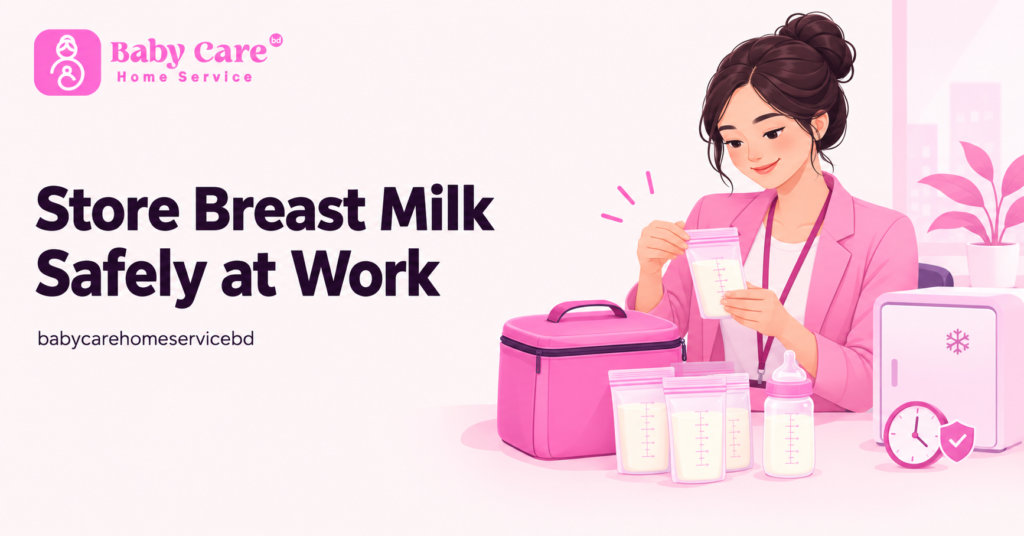
You are back at work. Your baby is at home. And your pumped milk is sitting in a bag, waiting for the right place to go. Sound familiar?
Many working mothers in Dhaka feel this pressure. You want your baby to keep getting your milk, but you also have meetings, traffic and a long day. Learning how to store breast milk the right way takes a big worry off your mind. It keeps the milk safe, and it keeps your baby healthy.
In this guide, you will learn how to pump at work, how to store breast milk at home and on the road, how to thaw it, and how to hand the job to a nanny or caregiver. Everything is in simple steps, so you can start today.
How to Store Breast Milk Safely: The Quick Answer
To store breast milk safely, wash your hands, pour the milk into a clean breast milk bag or food-safe container, write the date on it, and put it in the fridge or freezer right away. Fresh milk is good for up to 4 hours at room temperature, up to 4 days in the fridge, and about 6 months in the freezer.
These numbers come from the US Centers for Disease Control and Prevention (CDC), a trusted health source. Keep them in mind, because every tip on how to store breast milk in this post builds on them.
Why Does Knowing How to Store Breast Milk Matter for Working Mothers?
It matters because milk can grow germs if it sits out too long or is kept in the wrong place. Good storage also keeps the milk fresh, so your baby gets the full benefit.
When you are at work, you are not there to feed your baby. Someone else will give the bottle, and that person can only give safe milk if you store it well. Think of cooked rice on a hot day. If you leave it out for hours, nobody would eat it. Milk needs the same care, maybe even more, because babies are small and their bodies are still growing.
Good habits also save money and effort, and they make how to store breast milk feel like second nature. You waste less milk, and you feel calm because you know your baby is drinking safe milk.
How to Store Breast Milk: Time Chart for Room, Fridge and Freezer
Freshly pumped milk can stay at room temperature for up to 4 hours, in the fridge for up to 4 days, and in the freezer for 6 months for the best quality. Frozen milk is still fine up to 12 months, but it may lose some quality after 6.
Here is the full chart on how to store breast milk by time and place. You can print it and stick it on your fridge.
| Type of Milk | Room Temperature (up to 25°C) | Fridge (4°C) | Freezer (-18°C) |
|---|---|---|---|
| Freshly pumped milk | Up to 4 hours | Up to 4 days | Best within 6 months, okay up to 12 months |
| Thawed (was frozen) | 1–2 hours | Up to 24 hours | Never refreeze |
| Leftover from a feeding | Use within 2 hours after baby finishes | Not recommended | Never refreeze |
A small note for Dhaka mothers. Our summer rooms are often hotter than 25°C. In that case, do not wait for the full 4 hours. Cool the milk as soon as you can.
What Do You Need Before You Start Pumping?
You need a clean pump, an extra set of pump parts, storage bags or bottles, a marker, a small cooler bag with ice packs, and a clean place to sit. Having these ready is the first step in learning how to store breast milk at work without stress.
If you are buying a pump, ask your doctor or a nursing care professional which type suits you. A manual pump is cheap and quiet. An electric pump is faster, which helps if your lunch break is short.
How to Pump Breast Milk at Work: Step by Step
To pump at work, find a private and clean spot, wash your hands, set up your pump, and pump for 15 to 20 minutes. Do this at about the same times your baby would feed. Then store the milk right away.
Step 1: Talk to Your Employer Early
Before you return to work, ask your manager for a quiet room and short pumping breaks. Many mothers feel shy about this. Don’t be. It is a normal request, and a clear plan helps everyone.
Step 2: Set a Pumping Schedule
Try to pump about every 3 hours while you are away from your baby. A mother of a 3-month-old might pump at 10 a.m., 1 p.m. and 4 p.m. Your own timing may differ, and that is fine. The idea is to copy your baby’s feeding pattern so your body keeps making enough milk. Regular pumping also makes how to store breast milk easier, because you handle small, fresh batches.
Step 3: Pump and Pour Carefully
Wash your hands with soap and water first. Check that the pump parts are clean and dry. After you pump, pour the milk into a storage bag or bottle. Do not fill it to the top, because milk grows a little when it freezes.
Step 4: Label and Cool It Right Away
Write the date on every bag. If your baby is in childcare, add your baby’s name too. Then put the milk in a cooler bag with ice packs or in the office fridge. This is the most important part of how to store breast milk at work.
How to Store Breast Milk at Home
At home, put milk in the back of the fridge, not the door, and keep freezer milk toward the back too. The back stays colder and more steady, so the milk stays safe longer.
How to Store Breast Milk in the Fridge
To store breast milk in the fridge, keep it at the back at about 4°C and use it within 4 days. Never put it in the door. If you plan to use the milk in the next few days, the fridge is the best choice, because you can skip thawing.
How to Store Breast Milk in the Freezer
To store breast milk in the freezer, use bags or bottles with space at the top, label them, and keep them at the back. Freeze milk you will not use in 4 days. Here are some simple tips for the fridge and the freezer:
- Store milk in small amounts, like 60 to 120 ml (2 to 4 ounces). This is about what a baby drinks in one feeding, so nothing goes to waste.
- Keep a few tiny 30 ml portions too. They help when your baby is hungrier than usual.
- Lay freezer bags flat. They freeze faster, take less room and thaw quicker.
- Put the newest milk behind the older milk, so you always use the oldest first.
- Do not pour fresh warm milk on top of frozen milk. Cool it in the fridge first, then add it.
If you are not sure how to store breast milk when you pump more than once a day, here is an easy trick. Keep one bag or bottle for each pumping session, and label each with its own date.
Which Container Is Best for Storing Breast Milk?
When you learn how to store breast milk, the container is your first choice. The best containers are breast milk storage bags and clean, food-safe bottles with tight lids. Glass and hard plastic that is free from BPA both work well. Do not use ordinary plastic bags or disposable bottle liners.
| Container | Good Points | Things to Watch |
|---|---|---|
| Breast milk storage bags | Save space, easy to lay flat, easy to label | Can leak if overfilled |
| Glass bottles with lids | Easy to clean, can be reused | Heavy, can break |
| Hard plastic (BPA-free) bottles | Light and strong | Check the label for BPA |
| Normal food bags or bottle liners | None for milk | Not made for milk, so avoid them |
How to Store Breast Milk While Traveling to and From Work
Put the milk in a small insulated cooler bag with ice packs. Milk kept this way stays safe for up to 24 hours. Move it to the fridge as soon as you reach home.
Many mothers ask how to store breast milk while commuting. The answer is simple: keep it cold. Dhaka traffic can turn a one-hour trip into three. So the cooler bag is not a luxury. It is your safety net. Here is what to do:
- Cool the milk in the office fridge first, if you can.
- Pack the bags tightly with ice packs on the sides.
- Keep the cooler bag out of the sun and away from a hot car seat.
- Do not open the bag again and again.
- At home, put the milk straight into the fridge or freezer.
If the ice packs melt on a very hot day, move the milk to a fridge as early as you can and use it first.
How to Store Breast Milk During Hot Weather and Power Cuts
Keep the fridge and freezer doors closed as much as you can. A closed freezer holds the cold for a good while. If you are unsure whether the milk stayed cold enough, do not take a chance. Throw it out. That is the simplest rule on how to store breast milk when the power goes.
Load shedding can happen in Dhaka, especially in the hot months. A few ice packs in the freezer can help. If the power stays off for a long time, move the milk into a cooler bag with ice.
How Do You Thaw and Warm Frozen Breast Milk?
To thaw frozen breast milk, move it to the fridge the night before, or hold the sealed bag under lukewarm running water. Never use a microwave. Use thawed milk within 24 hours.
Always take out the oldest milk first. Thawing is the second half of how to store breast milk safely. Here are the safe ways to do it.
| Method | How It Works | Time Needed |
|---|---|---|
| In the fridge | Move the bag from freezer to fridge the night before | About 12 hours |
| Under lukewarm running water | Hold the sealed bag under the tap | 10–15 minutes |
| In a bowl of warm water | Place the sealed bag in warm (not hot) water | 10–15 minutes |
| Microwave | Never do this | Not safe |
Breast milk does not have to be warm. Some babies like it cold or at room temperature. If your baby likes it warm, place the bottle in a bowl of warm water for a few minutes. Do not heat milk on the stove or in the microwave. This can make hot spots that may burn your baby’s mouth.
Swirl the milk gently before feeding. This is the last step after you store breast milk and thaw it. It is normal for the cream to rise to the top, so don’t shake it hard. Once milk is thawed, never refreeze it. If the baby does not finish the bottle, throw away what is left after 2 hours.
How Do You Know If Breast Milk Has Gone Bad?
Fresh milk smells mild and slightly sweet. If it smells sour or rotten, throw it out. When in doubt, don’t risk it.
Some changes are normal. Milk may separate into cream and a watery layer, so swirl it gently. The color can look slightly blue, yellow or pale. A mild soapy smell after freezing is often fine too. But throw the milk away if it smells sour or rotten, if it stayed out longer than the safe time, or if it was thawed more than 24 hours ago.
Common Mistakes When Learning How to Store Breast Milk
Most mistakes are small and easy to fix once you know them. Do not fill bags to the top. Do not keep milk in the fridge door. Always write the date, freeze small portions of 60–120 ml, and use the oldest milk first. Never warm milk in a microwave, and never refreeze thawed milk.
How Can a Nanny or Caregiver Help With Breast Milk Feeding?
A trained nanny can warm the milk safely, feed your baby on time, wash bottles and keep a simple log of feeds. This gives you peace of mind while you are at work.
Handing your baby over is hard. But a good caregiver can make the day smoother, and a nanny who knows how to store breast milk and thaw it safely is a big help. Before the first day, sit with your nanny or baby caretaker and show the fridge, the freezer and the labels. Share how to store breast milk in your home, and stick a one-page note on the fridge. Ask them to use the oldest milk first, swirl and not shake, and throw away leftovers after 2 hours. Tell them what to do if the baby refuses a bottle.
If you are looking for help in Dhaka, Baby Care Home Service BD offers trained nannies who can support your baby’s meals and routine at home. You can read about the baby feeding service to see how it works. Parents with very young babies may like the newborn baby care service. And if you need night support so you can rest after a long day of work and pumping, look at the night baby care service.
Not sure which kind of help fits your family? Our posts on daycare vs nanny service in Dhaka and live-in vs part-time nanny can help you decide. You can also check the pricing plans for flexible hours. Your own recovery counts too, so read our guide on postpartum mother care. If you are new to all this, the first-time parents survival guide is a good next read.
Conclusion
Knowing how to store breast milk does not need to be hard. Once you learn how to store breast milk in small steps, it becomes a daily habit. Wash your hands, use clean bags or bottles, write the date, keep the milk cold and use the oldest milk first. Remember the basic times: 4 hours at room temperature, 4 days in the fridge and about 6 months in the freezer. Never refreeze thawed milk, and never use a microwave.
Now you know how to store breast milk at work, at home and on the road. Working and pumping is hard work. But with a little planning, a cooler bag and the right helper at home, you can do it. You do not have to do it alone.
If you need a trained nanny or caregiver in Dhaka to help with feeding and daily baby care, contact Baby Care Home Service BD today. Our team can also show you how to store breast milk in a way that fits your home. They can talk to you about your baby’s needs and your work hours.
Frequently Asked Questions (FAQs)
1. How to store breast milk for working mothers?
Pump into a clean breast milk bag or bottle, write the date and cool it right away in a cooler bag or fridge. Freeze extra milk in small portions of 60–120 ml.
2. Can I store breast milk in the fridge door?
It is better not to. This is a key rule in how to store breast milk. The door gets warmer each time you open it. Keep the milk at the back of the fridge, where the cold stays steady.
3. How long can pumped breast milk sit out at room temperature?
Up to 4 hours at 25°C or lower. In hot weather, do not wait that long. Cool it sooner.
4. Can I mix milk from different pumping sessions?
Yes, if the milk is cooled first. Do not add warm milk to cold or frozen milk. Use the date of the oldest milk on the bag. This is a small part of how to store breast milk well.
5. Can I refreeze thawed breast milk?
No. Never refreeze thawed milk. Use it within 24 hours if it was thawed in the fridge, and throw away leftovers after a feed within 2 hours.
6. Is it okay to give a baby cold breast milk?
Yes, and many parents skip warming after they learn how to store breast milk well. Breast milk does not need to be warm. If your baby likes it warm, place the sealed bottle in warm water. Never use a microwave.
7. Why does my stored breast milk smell different?
Some changes are normal after freezing, like a mild soapy smell. But if the milk smells sour or rotten, throw it away.
8. How can a nanny help with breast milk feeding?
Show your nanny how to store breast milk in your home on the first day. A trained nanny can thaw milk safely, feed your baby on time, clean bottles and note down every feed.
9. How to store breast milk without a fridge?
Keep the milk in a clean, closed container for up to 4 hours at room temperature of 25°C or lower. For longer trips, use an insulated cooler bag with ice packs for up to 24 hours.