
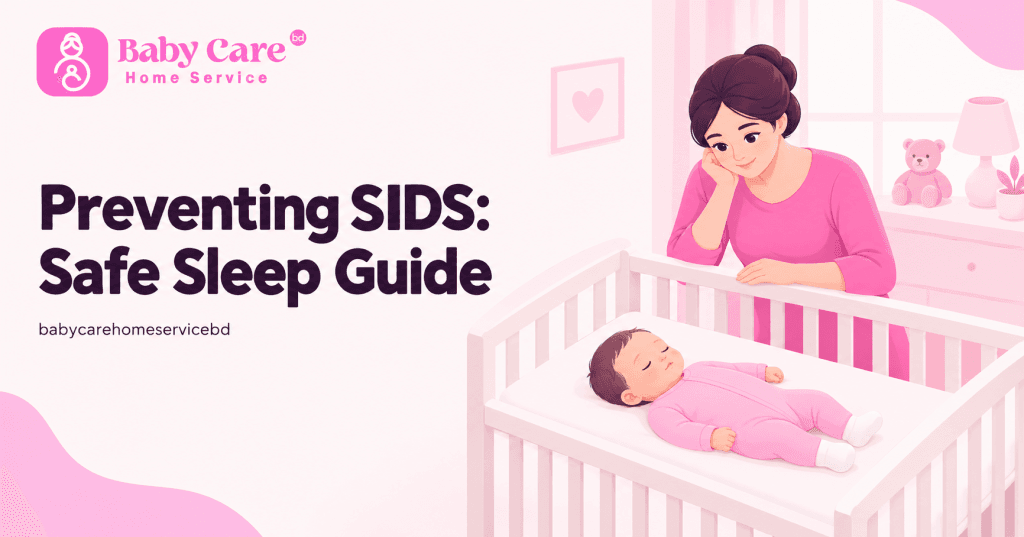
Becoming a parent brings joy, but it also brings worry. One of the biggest fears new parents carry is Sudden Infant Death Syndrome, or SIDS. It is a scary term, and not knowing much about it makes the fear worse. The good news is that SIDS is not as mysterious as it sounds, and there is a lot you can do to lower the risk. This guide from Babycare BD walks you through everything you need to know, in plain and simple language, so you can put your baby to sleep with more confidence and less anxiety.
Babycare BD works with hundreds of families across Dhaka every year, and safe sleep is one of the topics parents ask about the most. So we put together this complete guide, backed by medical guidelines, to help you understand SIDS and take real steps to protect your little one.
What Is SIDS? (Sudden Infant Death Syndrome Explained Simply)
SIDS is the sudden and unexplained death of a baby younger than one year old, usually while sleeping. Doctors call it “unexplained” because, even after a full check-up and investigation, no clear cause is found.
This does not mean nothing can be done. Researchers have studied thousands of SIDS cases and found clear patterns. Babies who sleep on their stomachs, sleep on soft bedding, or share a bed with an adult are at higher risk. That is why safe sleep habits matter so much. SIDS mostly affects babies between one month and six months old, and it is rare after the first birthday.
It helps to know that SIDS is different from suffocation caused by a blanket or pillow, though the two can look similar and often overlap in risk factors. Both are prevented in almost the same way, which is a relief for tired parents trying to remember a long list of rules.
Why Should Parents in Bangladesh Pay Extra Attention to This?
In many Bangladeshi households, babies sleep next to their mother on a soft bed, sometimes with pillows, bolsters, and blankets around them for warmth. This is done out of love, but it is one of the exact situations that raises SIDS risk. Add in our hot, humid weather, and you get another common habit: over-wrapping babies to protect them from mosquitoes or air conditioning, which can lead to overheating, another known risk factor.
Babycare BD sees this pattern often when our caregivers start working with a new family. Parents are not doing anything wrong on purpose. They simply have not been told which small habits carry risk. Once we explain it, most families are happy to make small changes that keep the same closeness and warmth, just in a safer way.
What Causes SIDS? Known Risk Factors Parents Should Know
There is no single cause of SIDS. Instead, doctors talk about a mix of risk factors that, together, raise the chance of it happening. The table below breaks this down clearly.
| Risk Factor | Why It Matters |
|---|---|
| Sleeping on the stomach or side | Makes it harder for baby to breathe freely and clear carbon dioxide |
| Soft mattress or soft bedding | Can trap air near baby’s face or cause overheating |
| Bed-sharing with parents | Raises risk of accidental rolling, overheating, or the baby getting trapped |
| Overheating | Too many clothes or blankets can raise body temperature and disturb natural sleep arousal |
| Smoking during pregnancy or at home | Nicotine affects the baby’s brain development and breathing control |
| Premature birth or low birth weight | Baby’s breathing and heart-rate control systems are less mature |
| No breastfeeding | Breast milk is linked with a lower SIDS risk, though the exact reason is still studied |
| Loose objects in the crib | Toys, pillows, and bumper pads can block airflow |
Babycare BD trains every caregiver to recognise and reduce each of these risks the moment they step into a family’s home, whether that means adjusting how a baby is dressed for sleep or gently guiding parents away from a soft, pillow-filled cot.
How Can You Prevent SIDS? Safe Sleep Rules Every Parent Should Follow
Doctors often summarise safe sleep with a simple phrase: Alone, on the Back, in a Crib. It is sometimes called the ABC rule, and it is easy to remember even when you are exhausted at 3 a.m. The steps below match the safe sleep guidance published by the U.S. Centers for Disease Control and Prevention (CDC), which is one of the most trusted sources on this topic worldwide.
1. Always Place Baby on Their Back to Sleep
This is the single most important rule. Every sleep, every nap, every time — baby should go down on their back, not their stomach or side. This has been proven, again and again, to lower SIDS risk. Once your baby can roll over both ways on their own, usually around 5 to 6 months, you do not need to flip them back if they roll during sleep.
2. Use a Firm, Flat Sleep Surface
A firm crib mattress with a tight-fitting sheet is what your baby needs. Soft mattresses, sofas, cushions, and adult beds are not safe sleep surfaces for a baby, even for a short nap.
3. Keep the Crib Bare
No pillows, no soft toys, no bumper pads, no loose blankets. It looks less “cosy” in photos, but a bare crib is a safe crib. If you are worried about cold nights, a wearable baby sleep sack is a much safer choice than a loose blanket.
4. Share the Room, Not the Bed
Keeping your baby’s cot in your room for at least the first six months makes night feeds easier and is linked to a lower SIDS risk. Bed-sharing, however, raises the risk, especially if a parent smokes, has had alcohol, is extremely tired, or the bed has soft bedding.
5. Avoid Overheating
Dress your baby in one extra layer compared to what you are wearing, not five. A hot room, thick blankets, and heavy clothing all raise the chance of overheating, which is linked with higher SIDS risk.
6. Breastfeed If You Can
Breastfeeding, even partially, is linked with a lower risk of SIDS. It is one more good reason, among many, to breastfeed for as long as it works for you and your baby.
7. Offer a Pacifier at Sleep Time
Giving a pacifier at nap time and bedtime has been shown to reduce SIDS risk, once breastfeeding is well established. If it falls out during sleep, there is no need to put it back in.
8. Keep Baby Away from Smoke
Smoke exposure, before and after birth, is one of the strongest risk factors for SIDS. A completely smoke-free home protects your baby’s lungs and lowers SIDS risk at the same time.
9. Do Not Rely on Products That Claim to Prevent SIDS
Wedges, positioners, special mattresses, and monitors that promise to “stop SIDS” are not proven to work, and some are actually unsafe. There is no product that replaces safe sleep habits and a caregiver who checks on the baby regularly.
What Should a Safe Sleep Space Look Like?
Sometimes a simple checklist helps more than a paragraph. Here is what to keep and what to remove from your baby’s sleep area.
| Do This | Avoid This |
|---|---|
| Firm mattress with fitted sheet | Soft mattress, waterbed, or sofa |
| Baby sleeps on their back | Baby sleeps on stomach or side |
| Baby sleeps in your room, own cot | Baby sleeps in a separate room, alone, in early months |
| Sleep sack or swaddle (before rolling starts) | Loose blankets, quilts, or comforters |
| Bare crib | Pillows, cushions, soft toys, bumper pads |
| Room temperature that feels comfortable, not hot | Overdressing or overheating the room |
| Pacifier at sleep time | Necklaces, hair bands, or strings near the crib |
Babycare BD asks families to run through a version of this checklist every night for the first year. It only takes a minute, and it becomes a habit fast.
Is Bed-Sharing Safe for Babies?
No, bed-sharing is not considered safe, and it raises the risk of SIDS and accidental suffocation. Room-sharing, where baby sleeps in their own crib in the parents’ room, gives you the same closeness without the added risk.
Many parents bed-share for comfort, easier night feeds, or because a separate cot feels far away. These reasons are understandable. If bed-sharing does happen occasionally, the risk goes up sharply when the bed has soft bedding, when a parent smokes or has been drinking, or when the baby is younger than four months. The safest choice is always a separate, firm sleep surface next to the parents’ bed.
How Babycare BD Nannies Help Keep Your Baby Safe While You Rest
New parents cannot stay awake all night, every night, checking on their baby. This is exactly where a trained night nanny makes a real difference. Every caregiver placed by Babycare BD is trained in safe sleep practices, including correct sleeping position, room temperature checks, and how to respond if a baby seems unwell during the night.
When you book a night nanny through Babycare BD, you are not just getting an extra pair of hands. You are getting a trained set of eyes that understands what a safe sleep space looks like and knows to check on your baby physically, rather than relying only on a monitor. Families who want round-the-clock peace of mind often pair this with our baby monitoring service, where a caregiver keeps a close, hands-on watch over feeding times, sleep position, and room comfort throughout the night.
If you are recovering from delivery, dealing with a difficult pregnancy history, or simply exhausted from broken sleep, our night baby care service is built exactly for this. Babycare BD caregivers follow the same safe sleep rules covered in this guide, every single night, so you can actually rest instead of lying awake worrying.
Common Myths About SIDS Prevention
Wrong information spreads fast, especially through relatives with strong opinions. Here are a few myths worth clearing up.
| Myth | Fact |
|---|---|
| A baby that sleeps on its stomach settles better, so it is fine | Back sleeping is proven safer, even if the baby seems to settle less quickly at first |
| Wrapping baby in extra blankets keeps them safer from cold | Overheating raises SIDS risk; a sleep sack is a safer choice |
| SIDS only happens to babies with health problems | SIDS can affect healthy babies with no prior symptoms |
| Baby monitors prevent SIDS | Monitors can help you respond faster, but they do not prevent SIDS on their own |
| Keeping baby in the same bed protects them more | Room-sharing without bed-sharing is the safer recommendation |
| It only happens in poor or unhygienic homes | SIDS occurs across all income levels and backgrounds |
Warning Signs and When to See a Doctor
SIDS itself gives no warning signs, which is part of what makes it so frightening. However, some related conditions do show symptoms, and these should never be ignored. Contact a doctor quickly if your baby has trouble breathing, turns bluish around the lips, feeds poorly, is unusually floppy, or has long pauses in breathing during sleep. Regular check-ups, on-time vaccinations, and a smoke-free home all support healthy breathing and development, which lowers overall risk.
If something feels off with your baby, trust that feeling. Parents usually notice small changes before anyone else does.
Conclusion: Small Habits, Real Protection
SIDS is frightening precisely because it feels unpredictable. But as this guide shows, most of the risk sits inside habits you can actually control: back sleeping, a bare firm crib, room-sharing instead of bed-sharing, a smoke-free home, and avoiding overheating. None of these require expensive products. They just require consistency, every nap and every night, for the first year.
You do not have to manage all of this alone. Babycare BD trains its nannies and caregivers in exactly these safe sleep practices, so your baby is looked after correctly even when you cannot be watching every minute. Whether you need a night nanny, daytime support, or a caregiver trained in baby monitoring, Babycare BD is ready to help your family sleep a little easier. Book a service with Babycare BD today and give your baby the safest possible start.
Frequently Asked Questions
1. What is the safest sleeping position for a baby?
The safest position is on the back, for every sleep, from birth until your baby can roll over both ways on their own. This single habit lowers SIDS risk more than almost anything else.
2. At what age is the risk of SIDS highest?
SIDS risk is highest between one and four months of age, and most cases happen before six months. Risk drops sharply after the first birthday.
3. Can a fan in the room help reduce SIDS risk?
Some studies suggest gentle air movement, such as a fan, may help lower risk by improving air circulation around the baby. It should never replace the core safe sleep rules, though.
4. Is it safe to swaddle my baby for sleep?
Swaddling is safe only until your baby starts trying to roll over, usually around 2 to 4 months. After that, switch to a wearable sleep sack so rolling is not restricted.
5. Does room-sharing really lower SIDS risk?
Yes, keeping your baby’s cot in your room for at least six months is linked with a meaningfully lower SIDS risk compared with a baby sleeping alone in a separate room.
6. Can vaccines cause SIDS?
No. Research has consistently found no link between vaccines and SIDS. In fact, keeping vaccinations on schedule is one of the recommended steps for overall infant health.
7. Does Babycare BD provide caregivers trained in safe sleep practices?
Yes. Every nanny and night caregiver from Babycare BD is trained in safe sleep guidelines, including correct sleep position, safe bedding, and how to respond to any warning signs.
8. Is it normal to feel anxious about SIDS as a new parent?
Yes, this worry is extremely common. Learning the real risk factors and following safe sleep steps consistently is the best way to turn anxiety into confident action.